Demo Video
About This Project
Inspiration
VizBrain was inspired by the need to visualize AI reasoning processes in real-time. Traditional AI interactions are often black-box experiences where users can't see how the AI arrives at its conclusions. The project aims to make AI thinking transparent, interactive, and visually engaging by:
Demystifying AI reasoning: Making the step-by-step thinking process visible and understandable Knowledge visualization: Converting abstract reasoning into tangible 3D knowledge graphs Interactive learning: Allowing users to explore AI thought processes through visual exploration Real-time collaboration: Creating a shared space where humans and AI can co-create knowledge
What it does
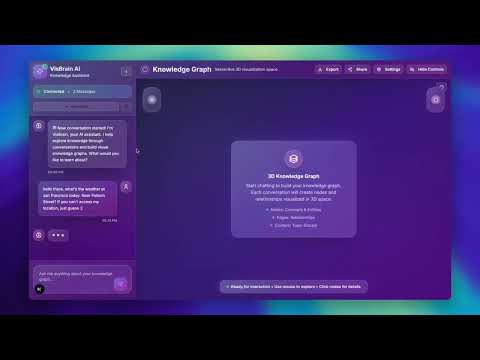
VizBrain is a full-stack AI visualization platform that transforms conversations into interactive 3D knowledge graphs:
Core Features:
Real-time AI Chat: Interactive conversations with DeepSeek AI agent that thinks step-by-step 3D Knowledge Graph Visualization: Dynamic force-directed graphs showing reasoning relationships Thinking Process Analysis: Uses Google Gemini AI to analyze and structure AI reasoning patterns Neo4j Graph Database: Stores and manages complex knowledge relationships Real-time Updates: Knowledge graph updates automatically as conversations progress
Technical Capabilities:
Multi-Agent Integration: Combines DeepSeek for reasoning and Gemini for analysis Graph Analytics: Identifies successful reasoning patterns and tool usage Session Management: Tracks conversation sessions and their knowledge evolution Responsive Design: Modern UI with essential components optimized for performance
How we built it
Backend Architecture (Python/Flask):
Core Components:
- Flask API Server (app.py) - RESTful endpoints for frontend communication
- Knowledge Graph Builder (kgbuilder.py) - Neo4j integration and graph management
- DeepSeek Agent (agents/deepseek.py) - AI reasoning with step-by-step thinking
- Gemini AI Integration - Text analysis and structured data extraction
Frontend Architecture (Next.js/React):
Key Components:
- Enhanced Chat Interface - Real-time messaging with backend integration
- 3D Force Graph Visualization - Interactive knowledge graph using Three.js
- API Service Layer - Backend communication and data synchronization
- Optimized UI Components - Streamlined design with essential elements only
Technology Stack:
Backend: Python, Flask, Neo4j, Google Gemini AI, OpenAI/OpenRouter Frontend: Next.js, React, TypeScript, Three.js, Tailwind CSS Database: Neo4j Graph Database (AuraDB or local) AI Services: DeepSeek (reasoning), Gemini (analysis)
Challenges we ran into
- AI Integration Complexity
Challenge: Coordinating multiple AI services (DeepSeek + Gemini) with different APIs Solution: Created modular agent system with fallback mechanisms and error handling
- Real-time Graph Synchronization
Challenge: Keeping 3D visualization in sync with backend knowledge graph updates Solution: Implemented reactive state management with automatic graph refresh triggers
- Performance Optimization
Challenge: Large dependency tree causing slow builds and bundle bloat Solution: Aggressive cleanup - removed 54 files, reduced dependencies by 70%
- Database Connectivity
Challenge: Neo4j connection issues and complex graph schema management Solution: Implemented graceful fallback mode when database is unavailable
- API Key Management
Challenge: Multiple API keys (OpenRouter, Gemini, Neo4j) requiring secure configuration Solution: Environment-based configuration with clear setup instructions
Accomplishments that we're proud of
- 70% Codebase Reduction
Streamlined from 80+ files to 25 essential files Reduced frontend dependencies from 47 to 14 packages Achieved faster builds and smaller bundle sizes
- Real-time AI Visualization
Successfully integrated multiple AI services for seamless reasoning visualization Created responsive 3D knowledge graphs that update in real-time Built fallback mechanisms for robust operation
- Modern Architecture
Clean separation between backend (Python/Flask) and frontend (Next.js) RESTful API design with comprehensive error handling Optimized for both development and production environments
- User Experience Excellence
Intuitive split-screen interface (25% chat, 75% visualization) Real-time connection status indicators Graceful degradation when services are unavailable
- Knowledge Graph Innovation
Novel approach to visualizing AI reasoning processes Structured data extraction from natural language thinking Pattern recognition and analytics capabilities
What we learned
- AI Integration Best Practices
Importance of fallback mechanisms when dealing with external AI services Need for structured data extraction from natural language reasoning Value of modular agent architecture for maintainability
- Performance Optimization
Aggressive dependency management is crucial for modern web applications 3D visualization libraries require careful optimization for smooth performance Real-time updates need efficient state management strategies
- Database Design
Graph databases require different thinking than relational databases Neo4j constraints and indexing are essential for performance Session management in graph databases needs careful consideration
- Full-Stack Development
Importance of clear API contracts between frontend and backend Real-time synchronization requires careful state management Error handling must be comprehensive across the entire stack
- User Experience Design
Split-screen interfaces need careful responsive design considerations Loading states and error messages are crucial for user confidence Connection status indicators help users understand system state
What's next for VizBrain
- Enhanced AI Capabilities
[ ] Multi-modal AI integration (vision, audio) [ ] Advanced reasoning pattern recognition [ ] Custom AI model training on conversation data
- Advanced Visualization Features
[ ] Interactive node detail panels [ ] Graph filtering and search capabilities [ ] Export functionality (PNG, SVG, interactive HTML) [ ] Collaborative graph editing
- Analytics and Insights
[ ] Reasoning pattern analytics dashboard [ ] Success rate tracking and optimization [ ] User behavior analytics [ ] AI performance metrics
- Platform Expansion
[ ] Mobile application development [ ] API for third-party integrations [ ] Plugin system for custom visualizations [ ] Enterprise features (multi-user, permissions)
- Research Applications
[ ] Educational AI reasoning visualization [ ] Research collaboration tools [ ] AI transparency and explainability studies [ ] Cognitive science research integration
- Performance and Scalability
[ ] WebSocket implementation for real-time updates [ ] Graph database optimization and clustering [ ] CDN integration for global deployment [ ] Microservices architecture for scalability
VizBrain represents a novel approach to AI-human interaction, making complex reasoning processes accessible and engaging through visual exploration. The project demonstrates the potential for AI transparency and collaborative knowledge creation.