VizBrain
Demo Video
About This Project
Inspiration
VizBrain was inspired by the need to visualize AI reasoning processes in real-time. Traditional AI interactions are often black-box experiences where users can't see how the AI arrives at its conclusions. The project aims to make AI thinking transparent, interactive, and visually engaging by:
Demystifying AI reasoning: Making the step-by-step thinking process visible and understandable Knowledge visualization: Converting abstract reasoning into tangible 3D knowledge graphs Interactive learning: Allowing users to explore AI thought processes through visual exploration Real-time collaboration: Creating a shared space where humans and AI can co-create knowledge
What it does
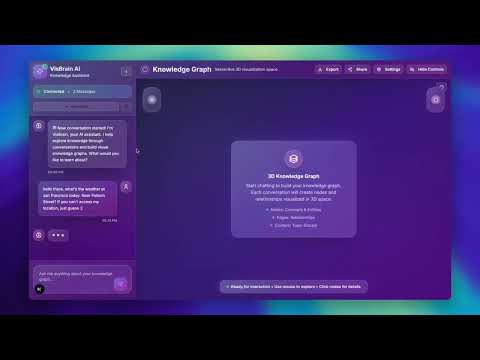
VizBrain is a full-stack AI visualization platform that transforms conversations into interactive 3D knowledge graphs:
Core Features:
Real-time AI Chat: Interactive conversations with DeepSeek AI agent that thinks step-by-step 3D Knowledge Graph Visualization: Dynamic force-directed graphs showing reasoning relationships Thinking Process Analysis: Uses Google Gemini AI to analyze and structure AI reasoning patterns Neo4j Graph Database: Stores and manages complex knowledge relationships Real-time Updates: Knowledge graph updates automatically as conversations progress
Technical Capabilities:
Multi-Agent Integration: Combines DeepSeek for reasoning and Gemini for analysis Graph Analytics: Identifies successful reasoning patterns and tool usage Session Management: Tracks conversation sessions and their knowledge evolution Responsive Design: Modern UI with essential components optimized for performance
How we built it
Backend Architecture (Python/Flask):
Core Components:
- Flask API Server (app.py) - RESTful endpoints for frontend communication
- Knowledge Graph Builder (kgbuilder.py) - Neo4j integration and graph management
- DeepSeek Agent (agents/deepseek.py) - AI reasoning with step-by-step thinking
- Gemini AI Integration - Text analysis and structured data extraction
Frontend Architecture (Next.js/React):
Key Components:
- Enhanced Chat Interface - Real-time messaging with backend integration
- 3D Force Graph Visualization - Interactive knowledge graph using Three.js
- API Service Layer - Backend communication and data synchronization
- Optimized UI Components - Streamlined design with essential elements only
Technology Stack:
Backend: Python, Flask, Neo4j, Google Gemini AI, OpenAI/OpenRouter Frontend: Next.js, React, TypeScript, Three.js, Tailwind CSS Database: Neo4j Graph Database (AuraDB or local) AI Services: DeepSeek (reasoning), Gemini (analysis)
Challenges we ran into
- AI Integration Complexity
Challenge: Coordinating multiple AI services (DeepSeek + Gemini) with different APIs Solution: Created modular agent system with fallback mechanisms and error handling
- Real-time Graph Synchronization
Challenge: Keeping 3D visualization in sync with backend knowledge graph updates Solution: Implemented reactive state management with automatic graph refresh triggers
- Performance Optimization
Challenge: Large dependency tree causing slow builds and bundle bloat Solution: Aggressive cleanup - removed 54 files, reduced dependencies by 70%
- Database Connectivity
Challenge: Neo4j connection issues and complex graph schema management Solution: Implemented graceful fallback mode when database is unavailable
- API Key Management
Challenge: Multiple API keys (OpenRouter, Gemini, Neo4j) requiring secure configuration Solution: Environment-based configuration with clear setup instructions
Accomplishments that we're proud of
- 70% Codebase Reduction
Streamlined from 80+ files to 25 essential files Reduced frontend dependencies from 47 to 14 packages Achieved faster builds and smaller bundle sizes
- Real-time AI Visualization
Successfully integrated multiple AI services for seamless reasoning visualization Created responsive 3D knowledge graphs that update in real-time Built fallback mechanisms for robust operation
- Modern Architecture
Clean separation between backend (Python/Flask) and frontend (Next.js) RESTful API design with comprehensive error handling Optimized for both development and production environments
- User Experience Excellence
Intuitive split-screen interface (25% chat, 75% visualization) Real-time connection status indicators Graceful degradation when services are unavailable
- Knowledge Graph Innovation
Novel approach to visualizing AI reasoning processes Structured data extraction from natural language thinking Pattern recognition and analytics capabilities
What we learned
- AI Integration Best Practices
Importance of fallback mechanisms when dealing with external AI services Need for structured data extraction from natural language reasoning Value of modular agent architecture for maintainability
- Performance Optimization
Aggressive dependency management is crucial for modern web applications 3D visualization libraries require careful optimization for smooth performance Real-time updates need efficient state management strategies
- Database Design
Graph databases require different thinking than relational databases Neo4j constraints and indexing are essential for performance Session management in graph databases needs careful consideration
- Full-Stack Development
Importance of clear API contracts between frontend and backend Real-time synchronization requires careful state management Error handling must be comprehensive across the entire stack
- User Experience Design
Split-screen interfaces need careful responsive design considerations Loading states and error messages are crucial for user confidence Connection status indicators help users understand system state
What's next for VizBrain
- Enhanced AI Capabilities
[ ] Multi-modal AI integration (vision, audio) [ ] Advanced reasoning pattern recognition [ ] Custom AI model training on conversation data
- Advanced Visualization Features
[ ] Interactive node detail panels [ ] Graph filtering and search capabilities [ ] Export functionality (PNG, SVG, interactive HTML) [ ] Collaborative graph editing
- Analytics and Insights
[ ] Reasoning pattern analytics dashboard [ ] Success rate tracking and optimization [ ] User behavior analytics [ ] AI performance metrics
- Platform Expansion
[ ] Mobile application development [ ] API for third-party integrations [ ] Plugin system for custom visualizations [ ] Enterprise features (multi-user, permissions)
- Research Applications
[ ] Educational AI reasoning visualization [ ] Research collaboration tools [ ] AI transparency and explainability studies [ ] Cognitive science research integration
- Performance and Scalability
[ ] WebSocket implementation for real-time updates [ ] Graph database optimization and clustering [ ] CDN integration for global deployment [ ] Microservices architecture for scalability
VizBrain represents a novel approach to AI-human interaction, making complex reasoning processes accessible and engaging through visual exploration. The project demonstrates the potential for AI transparency and collaborative knowledge creation.
Tracks
Built With
Repository
Submitted December 26, 2025 at 1:03 AM